


The ecology of sounds
With the accelerating pace of conversion of natural landscapes to human-dominated ones, complex patterns of land-use and change emerge. These changes affect wildlife that live within human-dominated landscapes, even when they inhabit protected natural areas. One way to understand the impact on wildlife, including patterns and drivers of biodiversity over time and space, is through the study of sound
Using passive acoustic monitoring, we are currently investigating:
-
the extent of noise intrusions into natural protected areas occurring within human-dominated landscapes
-
patterns and drivers of acoustic diversity over time and space in natural areas within human-dominated landscapes
-
impacts of reproductive and survival threats on acoustic communities
-
the structure of acoustic communities and partitioning of acoustic niches
-
soil soundscapes over time and space
-
restoration impacts on soil and airborne soundscapes
Selected Publications
Gill, S.A., E.E. Grabarczyk, K.M. Baker, K. Naghshineh & M.J. Vonhof. 2017. Decomposing an urban soundscape to reveal patterns and drivers of variation in anthropogenic noise. Science of the Total Environment 599-600:1191-1201.
Job, J. R., K. Myers, K. Naghshineh & S. A. Gill. 2016. Uncovering spatial variation in acoustic environments using sound mapping. PLoS ONE 11(7): e0159883
Sblendorio, J., M.J. Vonhof & S.A. Gill. 2024. Migratory singers dynamically overlap the signal space of a breeding warbler community. Ecology & Evolution 14, e11013. https://doi.org/10.1002/ece3.11013
Research on soundscapes funded by a grant from the Eppley Foundation for Scientific Research and Western Michigan University's Faculty Research and Creative Activities Award.
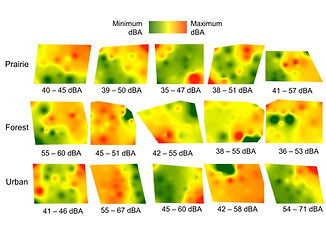
We adapted noise mapping procedures to visualize sound over 60x60 m plots. Sound pressure levels vary considerably even over small spatial scales in prairie, forest and urban habitats (Job et al. 2016)